

« A wallet that simulates every transaction will make you invulnerable » — that’s a tempting claim on Twitter, but it’s a myth. Rabby Wallet’s pre-transaction simulation and risk scanning are powerful tools that reduce particular classes of user error and smart-contract trickery, yet they are not a panacea. This article untangles what Rabby actually does, where it moves the security needle for active DeFi users in the US, and where its protections meet hard limits that still require user judgment and operational controls.
Startlingly concrete benefit: Rabby surfaces estimated token balance changes and fee breakdowns before you sign, turning an opaque JSON payload into something you can reasonably audit with a glance. That matters for power users who routinize cross-chain swaps, approvals, and contract interactions. But the full story requires parsing mechanisms, trade-offs, and the residual risks that remain even after simulation and gating.
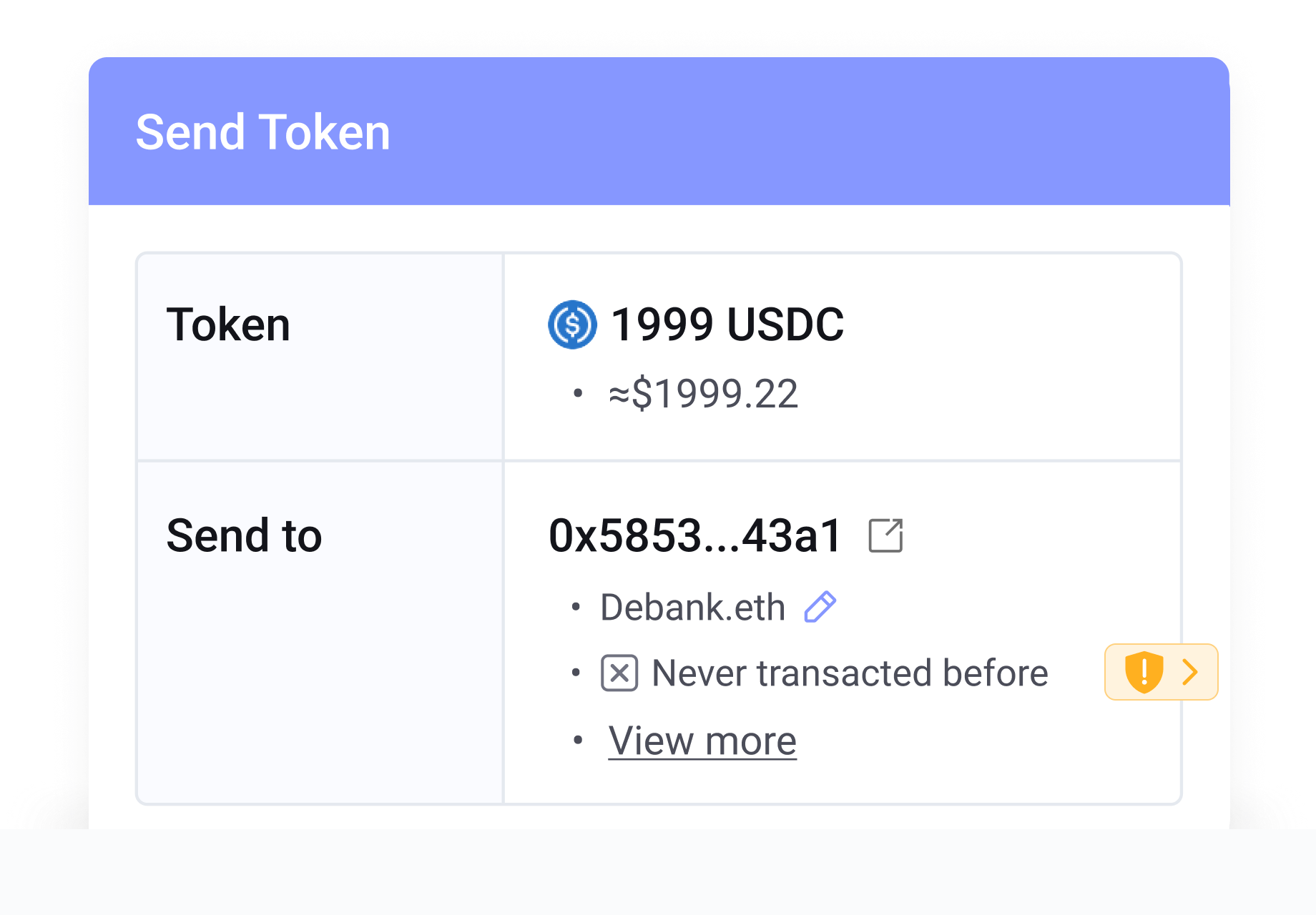
How Rabby’s core mechanics change the signing decision
Mechanism first: Rabby is a non-custodial, multi-chain browser extension and app created by DeBank. It intercepts dApp requests like any Web3 wallet, but before forwarding a signature it performs three linked actions: (1) simulate the transaction locally to predict token balance and gas impact, (2) run a pre-transaction risk scan against a security engine that flags hacked contracts, suspicious approvals, and missing recipients, and (3) present a concise human-readable summary including exact estimated token deltas and fee costs. For power users who sign many transactions per day, this converts blind signing into informed signing.
This simulation is not magic — it replays or predicts state changes given current chain state. That approach yields a useful, often precise estimate of immediate outcomes (balance changes, fees). It significantly reduces classically avoidable losses: e.g., approving an unlimited allowance by accident, or sending tokens to a burn address hidden behind an obfuscated contract call. In other words, Rabby rearranges the information asymmetry in favor of the user, but it cannot change the underlying correctness or trustworthiness of the smart contract code you call.
Common myths and the reality beneath them
Myth 1: « Transaction simulation blocks exploits. » Reality: simulations detect many anomalous outcomes and make them visible, but they do not prevent exploits that arise from legitimate-looking calls to compromised contracts or from logic flaws exploitable off the simulated path. A simulation is only as good as the chain state, the model of the contract, and the attacker’s mode of operation. Rabby’s simulation reduces the probability of accidental loss but cannot guarantee immunity to adaptive exploits.
Myth 2: « Automatic network switching is dangerous because it can trick users. » Reality: auto-switching reduces an operational friction that frequently causes errors (users trying to transact on the wrong chain). It can, however, be surprising if users assume they’re always on a single network. For power users, the right mental model is: auto-switching is a convenience that needs to be paired with a routine « confirm network and gas token » glance before signing, not an abdication of vigilance.
Myth 3: « Open-source wallet code equals safe. » Reality: open-source mitigates some systemic risks by enabling audits, but it doesn’t close human-error vectors (seed phrase theft, compromised browser extensions, social engineering). Rabby is MIT-licensed and auditable, which is a material advantage, but open code is a necessary condition for independent review — not a guarantee.
Where Rabby distinctly helps — and where it doesn’t
Distinct advantages for DeFi power users:
– Transaction simulation that communicates token deltas and precise fee estimates, which concretely reduces blind-signing errors.
– Pre-transaction risk scanning and approval revocation tools that let users list and cancel token allowances across dApps, diminishing long-lived exposure to malicious contracts.
– Automatic network switching and cross-chain gas top-up features that ease multi-chain workflows and reduce failed transactions because of missing native gas.
– Hardware-wallet compatibility and integrations with Gnosis Safe, Fireblocks, and other custodial/multi-sig solutions, which matter for institutional or higher-value operational setups.
Known gaps and trade-offs:
– No built-in fiat on-ramp: U.S. users still need to convert USD to crypto off-wallet via exchanges or third-party services before using Rabby to manage assets.
– No native in-wallet staking UI: you can stake via downstream dApps, but there is no unified, built-in staking experience within Rabby itself.
– Simulation limits: replaying a transaction against current state doesn’t capture every dynamic attack (e.g., MEV sandwiching, front-running that changes mempool ordering, or oracle-based manipulations that happen between simulation and execution). Power users should treat simulations as highly informative but not definitive.
How Rabby compares with familiar alternatives
Compare mechanistically rather than rhetorically. MetaMask, Trust Wallet, and Coinbase Wallet are broader consumer entry points. Rabby differentiates by instrumenting the signing step: its pre-sign simulation and risk engine are behavioral and interface-level mitigations that change the user’s decision-making. If you manage many approvals, multi-chain positions, or institutional flows, Rabby’s approval revocation and enterprise integrations are not just convenience — they’re operational guards that reduce attack surface over time.
That said, mainstream wallets have their own strengths (fiat on-ramps, larger user bases, and sometimes tighter exchange integrations). The trade-off is explicit: Rabby optimizes for transactional visibility and multi-chain DeFi workflows at the cost of a few consumer conveniences.
Practical framework: When to choose Rabby and how to use it safely
Decision heuristic for U.S.-based DeFi power users:
1) If you routinely interact with many EVM chains (Arbitrum, Optimism, Polygon, Avalanche, BNB Chain) and execute complex DeFi flows, Rabby’s multi-chain aggregation and automatic switching materially reduce time and error cost.
2) If you hold assets in hardware wallets or need multi-sig custody, Rabby’s integrations lower organizational risk when paired with best practices (air-gapped seed storage, stepped withdrawal policies, and mandatory secondary approvals for high-value transactions).
3) If you do frequent token approvals or lend/borrow positions, use Rabby’s approval revocation tool as part of a weekly hygiene routine — this is low effort with disproportionate security upside.
Operational checklist before signing anything with Rabby:
– Confirm the displayed token deltas and gas estimate match your expectation. If the delta is larger than the UI suggests it should be, pause.
– Verify counterparty contract addresses off a reliable source (project docs, community audits). Rabby will flag known hacked addresses, but new malicious contracts can evade databases.
– Prefer hardware-backed signatures for higher-value operations; Rabby supports Ledger, Trezor, and others.
What broke in the past, and why the response matters
Transparent, unvarnished note: a Rabby Swap smart contract was exploited in 2022 resulting in roughly $190,000 in losses. The team froze the contract, compensated affected users, and expanded audits. That sequence matters because it shows both the non-zero risk of integrated smart contracts and the governance and response maturity of a project. For users: prefer wallets that have both defensive UX (like simulations) and a demonstrated playbook for incident response.
Near-term signals and what to watch next
Rabby’s strengths are structural: simulation, approval controls, cross-chain ergonomics, and enterprise hooks. Signals that would materially change the calculus for U.S. users include: the addition of an in-wallet fiat on-ramp; a first-class staking UI; or substantive security incidents tied to systemic tooling rather than a single contract. Each would change the convenience-security trade-off in predictable ways. Monitor release notes and independent audits, and treat repeated or unexplained changes in the risk scanner’s database as a signal to re-evaluate reliance on automated flags.
If you want to install and experiment with the extension in a low-risk way, install the extension, connect a read-only wallet or small test account, and try standard flows (swap, approve, revoke) to learn what the simulations surface. A small exercise like this converts abstract assurances into muscle memory and improves safe behavior.
For installation and an official browser extension download, see the rabby wallet extension.
FAQ
Does Rabby eliminate the need for a hardware wallet?
No. Rabby supports hardware wallets and the safest setup for high-value accounts is still a hardware-backed key. Rabby’s simulations reduce some UI-level risks, but they cannot protect a private key once it is copied or exfiltrated from a compromised environment.
Can Rabby prevent MEV or front-running?
Not directly. Rabby’s simulation reads current chain state and estimates outcomes; it cannot secure transactions from mempool reordering, front-running bots, or oracle manipulations occurring after the simulation. Users who need MEV protection should combine Rabby with transaction relay services or private transaction submission where appropriate.
Is Rabby safe for institutional workflows?
Rabby integrates with multi-sig and custody tools like Gnosis Safe and Fireblocks, which is a point in its favor for institutional usage. However, institutional safety depends on process controls, multisig policy, and operational segregation — not only on the wallet UI. Treat Rabby as one component in a larger security architecture.
What should I do if Rabby flags a contract as hacked?
Pause and cross-check. Look up independent reports, check the project’s communication channels, and avoid interacting until third-party sources corroborate. Rabby’s flag is an alert, not a court ruling — use it to trigger due diligence.
How does Rabby handle token approvals?
Rabby lists active approvals and offers a revocation interface. Regularly revoking unused approvals lowers your exposure to approvals-based theft. For high-value operations, prefer explicit limited allowances instead of unlimited approvals.